Every dwikkoji has the same anatomy: a pointed end that slides into the chignon, and a decorated head that shows. What changes is the head, and the head gives each type its name.
Korean sources divide dwikkoji into two families. Decorative dwikkoji exist to make the hair more beautiful. Practical dwikkoji combine ornament with a daily use. Here are the classic forms of each.
Decorative dwikkoji
Gwapan — the chrysanthemum (과판)
The most representative ordinary dwikkoji was the gwapan, topped with a chrysanthemum flower. Seen from behind, a round flower head sits neatly on the curve of the chignon. Gwapan were made in silver, enamel, coral and jadeite. The chrysanthemum blooms late in the year, after other flowers have gone, so it stands for steadfastness and a long life.
Yeonbong — the lotus bud (연봉)
A yeonbong dwikkoji is topped with a lotus bud just about to open. It is one of the simplest and most elegant forms: an upright, closed bud on a short stem. The lotus rises clean from muddy water, and in Joseon literati culture it stood for integrity. Because the bud holds the promise of seeds, it was also a wish for children.
Maehwa — the plum blossom (매화)
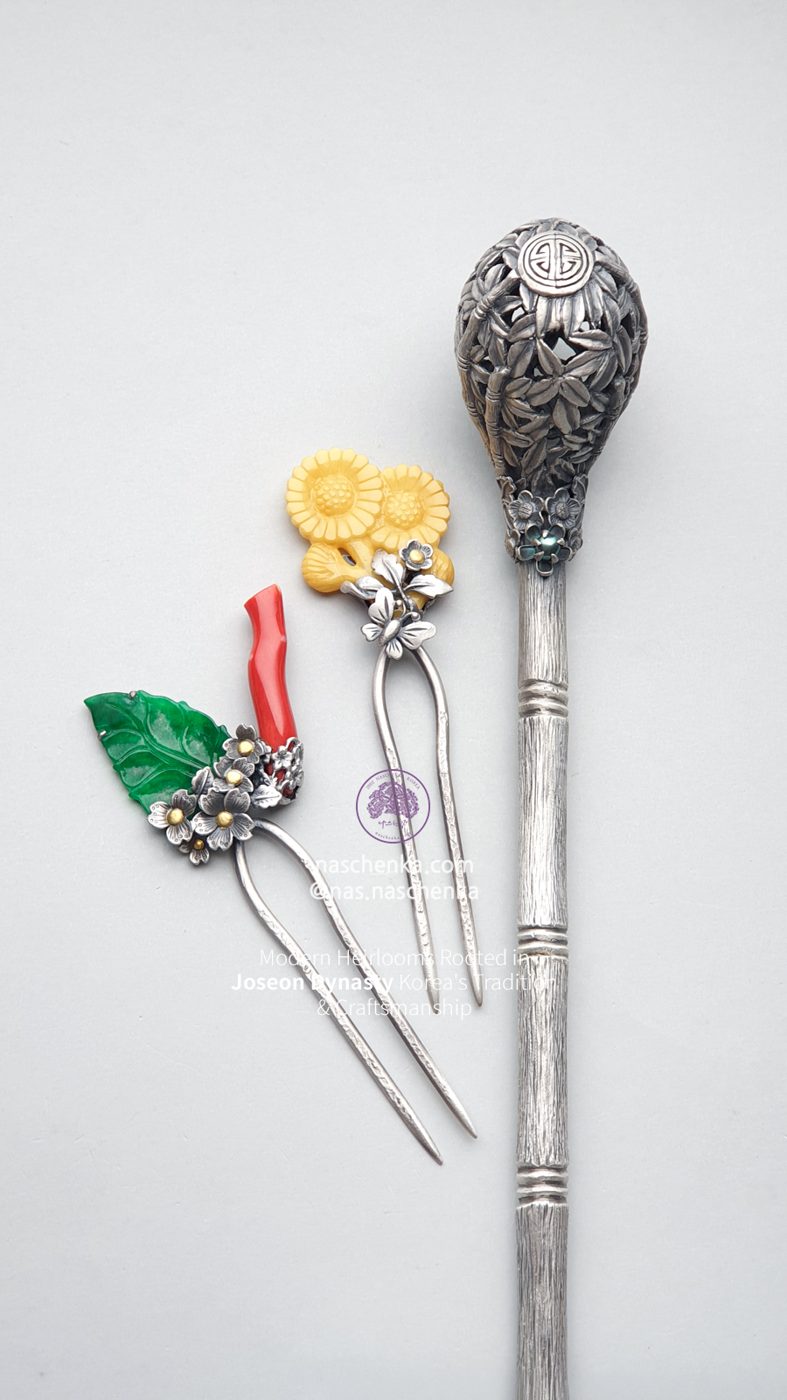
The plum flowers at the end of winter, often through snow. Plum-blossom ornaments, especially when paired with bamboo, were worn as a sign of a woman's integrity and constancy. Museums such as the Sookmyung Women's University Museum hold Joseon hairpins in this design.
Hwajeop — flower and butterfly (화접)
Hwajeop means "flower and butterfly". It shows a butterfly settling on a chrysanthemum or plum blossom, and it is one of the most typical Joseon designs. A butterfly drawn to a flower is an image of love and a happy couple, so hwajeop pieces were favourites for brides. The Victoria and Albert Museum in London holds an early twentieth-century example.
Nabi — the butterfly (나비)
A butterfly on its own, often with filigree or enamelled wings. It is worn alone or as a pair, one on each side of the chignon.
Cheondo — the heavenly peach (천도)
The cheondo is the peach of the immortals. In East Asian legend it ripened only once in thousands of years and granted long life to whoever ate it. A peach-headed dwikkoji, often carved in coral, was a wish for longevity.
Bong — the phoenix (봉)
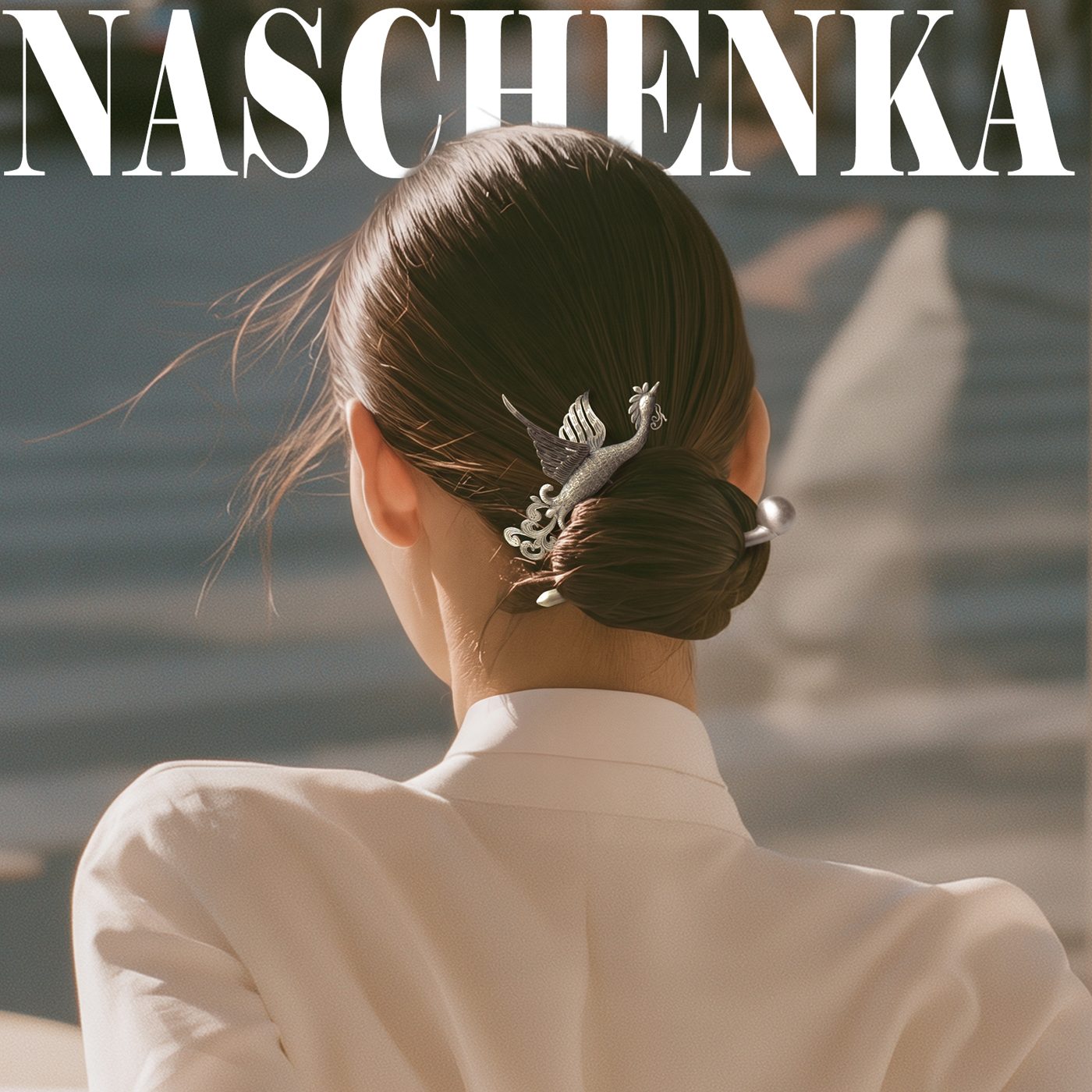
The phoenix was the queen's bird and a symbol of the highest rank, virtue and good fortune. Phoenix dwikkoji were among the grandest forms and belong mostly to court and ceremonial use.
Multi-pronged dwikkoji
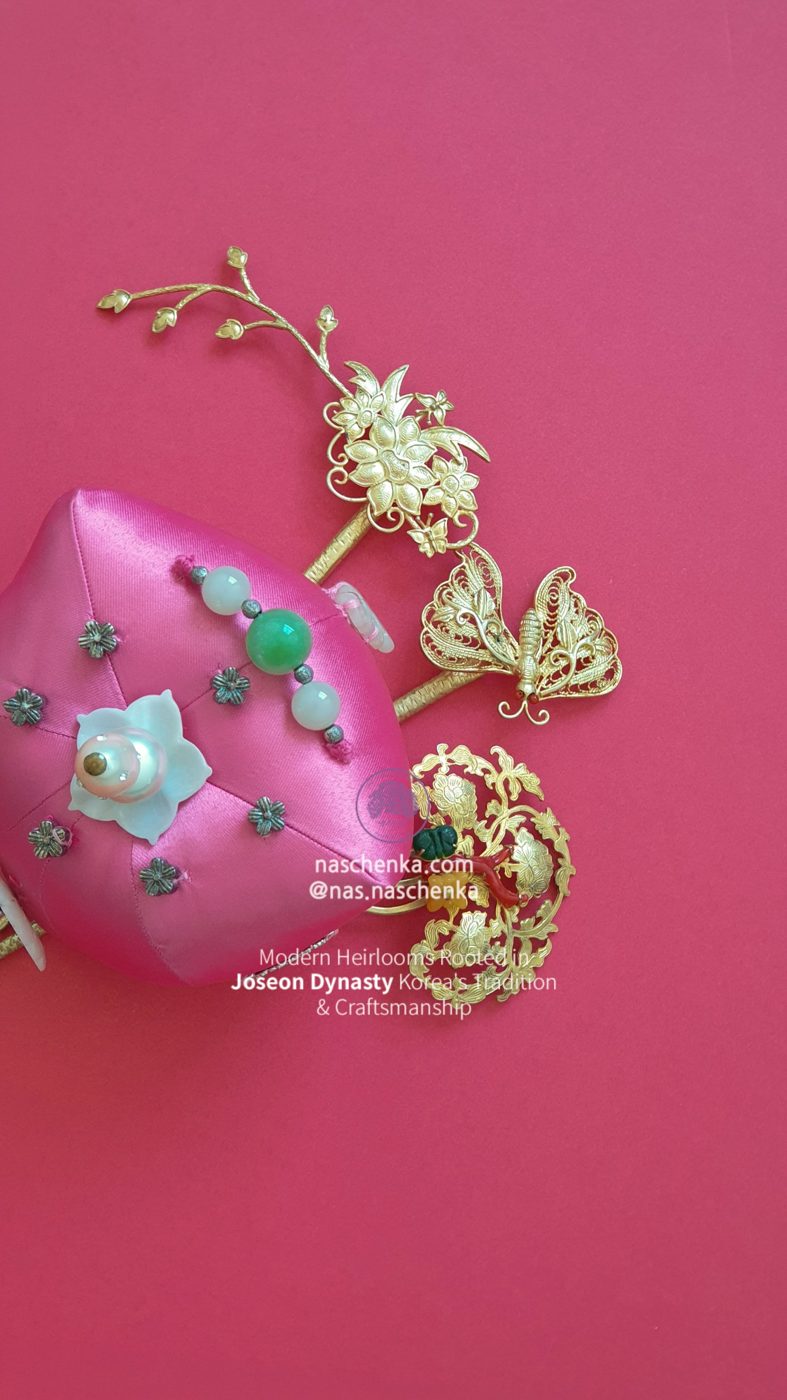
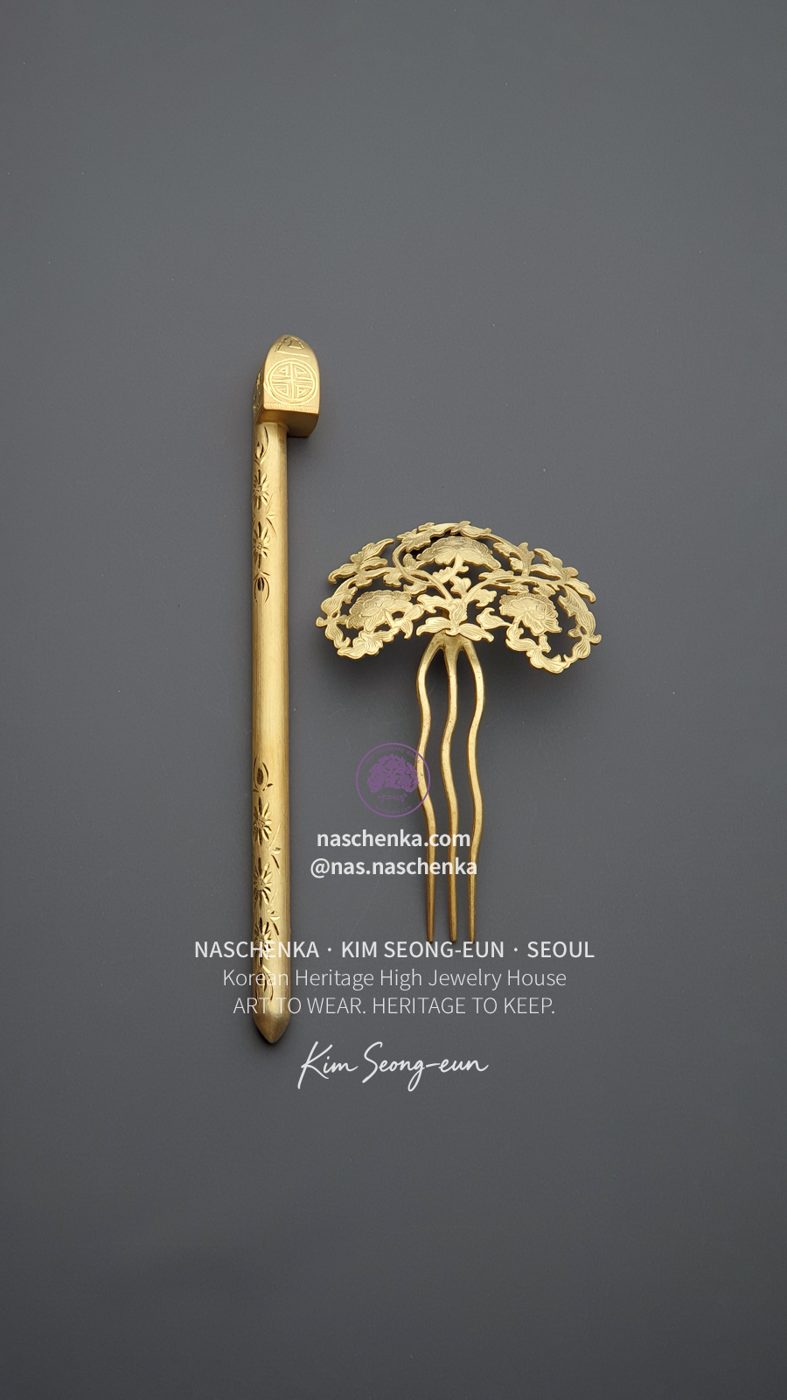
Not every dwikkoji has a single point. Some have two or three prongs, like a small comb, under a wide openwork head. The prongs grip the chignon securely and carry a larger ornament: a spray of peony, a cluster of flowers, a pierced panel set with coral. Small golden ornaments with three legs from the Three Kingdoms period are often cited as distant ancestors of this form.
Practical dwikkoji
Guiigae — the ear pick (귀이개)
One end of the guiigae is a tiny spoon for cleaning the ears, and the other a decorated head. It was kept in the hair so it was always at hand. The most common everyday form was made in plain or engraved silver. Some versions combined an ear pick with several extra prongs branching like twigs.
Bichigae — the parting tool (빗치개)
The bichigae has a flat, tapering blade. Women used it to apply camellia oil, draw the straight centre parting of the jjokjin-meori, and clean the teeth of a comb. Then it went back into the chignon as an ornament. Bichigae heads were often shaped as a gourd, a butterfly or a moon.
Forms worn in sets
Samjak — the set of three (삼작)
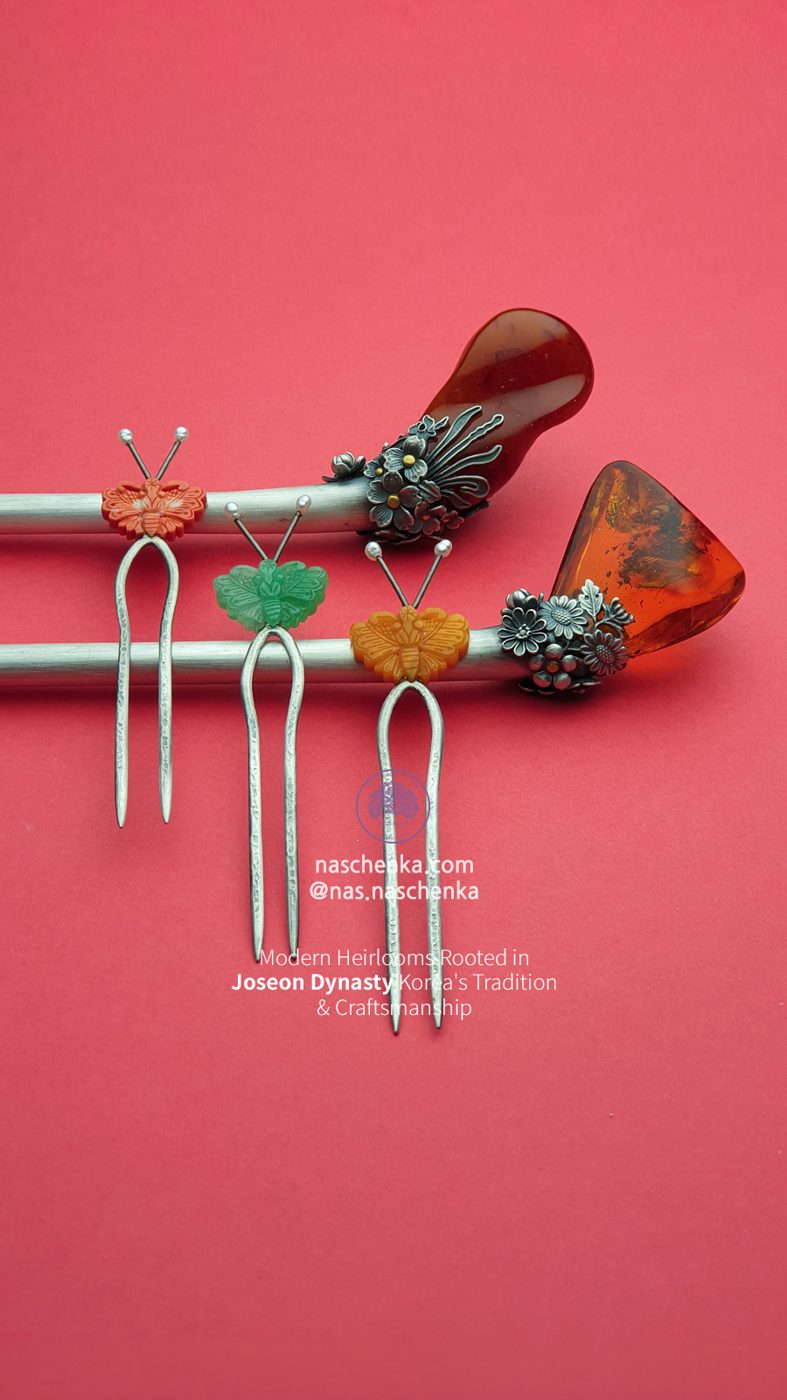
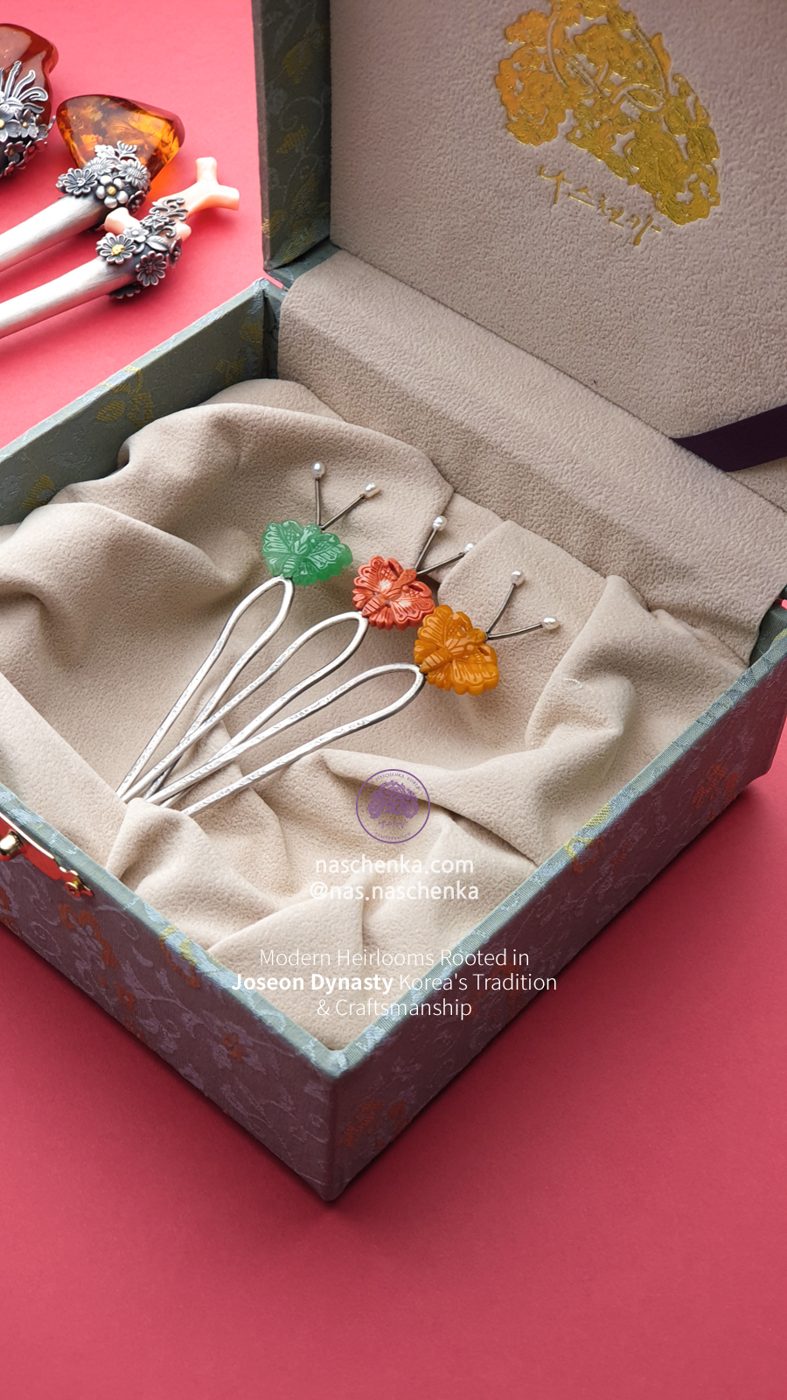
For special occasions, dwikkoji were worn in coordinated groups. A set of three in different materials, typically coral, amber and jadeite, gave the chignon a balanced range of red, gold and green.
Trembling ornaments
At court, the most magnificent hair ornament was the tteoljam (떨잠). A carved jade plate was set with pearl, coral, jadeite and enamel, and surrounded by small figures on fine coiled springs that quivered at every step. Three were worn together on the great ceremonial wig: one in front, one on each side. The Encyclopedia of Korean Culture counts the tteoljam as a kind of dwikkoji, since it too is an ornament added to dressed hair. Contemporary makers sometimes borrow the trembling spring for smaller pieces worn in an everyday chignon.
Which type should I choose?
- For a first dwikkoji: a flower or lotus bud in silver. It is the most classic and suits any occasion.
- For a bride: hwajeop (flower and butterfly) or a pair of butterflies, for happiness in marriage.
- For the mother of the bride or groom: a coral or jadeite flower worn with a silver or gold-plated binyeo.
- As a gift for an elder: a heavenly peach or chrysanthemum, both wishes for long life.
- For a collector: a practical form, such as an ear pick or parting tool, for its history; or a multi-pronged openwork piece for its craftsmanship.
Read on to learn what each motif means, or browse the NASCHENKA dwikkoji collection.
References
- Encyclopedia of Korean Culture — 뒤꽂이 (Dwikkoji)
- Academy of Korean Studies, Korean Costume Dictionary — 뒤꽂이
- Encyclopedia of Korean Culture — 떨잠 (Tteoljam)
- Victoria and Albert Museum — Ornamental hairpin (dwikkoji), Korea, early 20th century
- Sookmyung Women's University Museum — Chilbo hairpin with plum and bamboo (Google Arts & Culture)