Korean women of the Joseon era wore a whole family of hair ornaments. Each had its own place, purpose and rules. Here is how they fit together.
| Ornament | Korean | Where it is worn | What it does |
|---|---|---|---|
| Binyeo | 비녀 | Through the chignon | Holds the chignon in place |
| Dwikkoji | 뒤꽂이 | Back of the chignon | Decorates the set hair; some forms are tools |
| Cheopji | 첩지 | On the parting, at the top of the head | Marks rank; steadies a ceremonial crown |
| Tteoljam | 떨잠 | Front and sides of a ceremonial wig | Court ornament that trembles as the wearer moves |
| Daenggi | 댕기 | End of the braid, or hanging from the chignon | Ribbon that ties and decorates the hair |
| Jokduri | 족두리 | On top of the head | Small ceremonial crown, worn by brides |
| Hwagwan | 화관 | On top of the head | Flower crown for weddings and banquets |
| Gache | 가체 | Built onto the head | Wig of extra hair; banned in the 18th century |
Binyeo 비녀
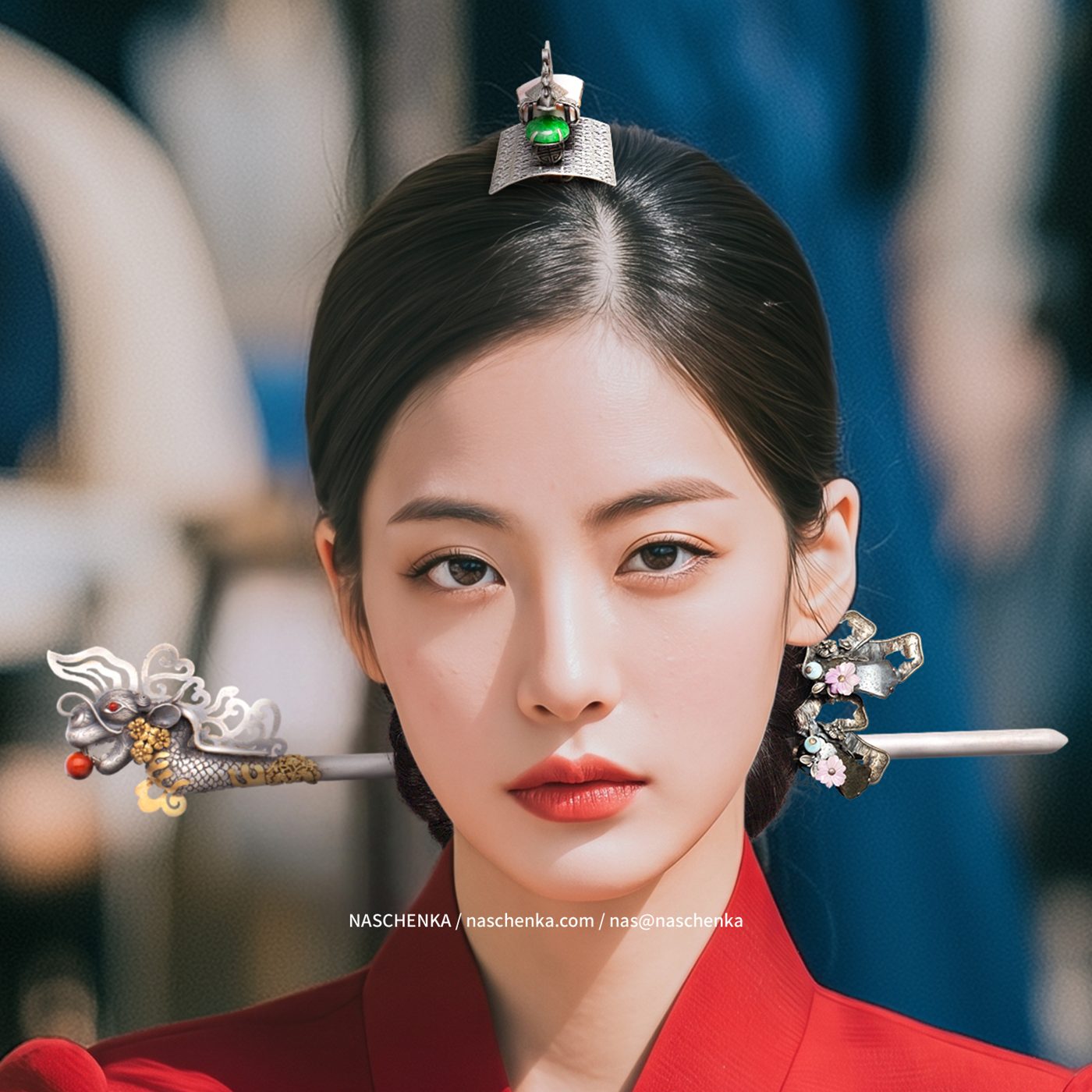
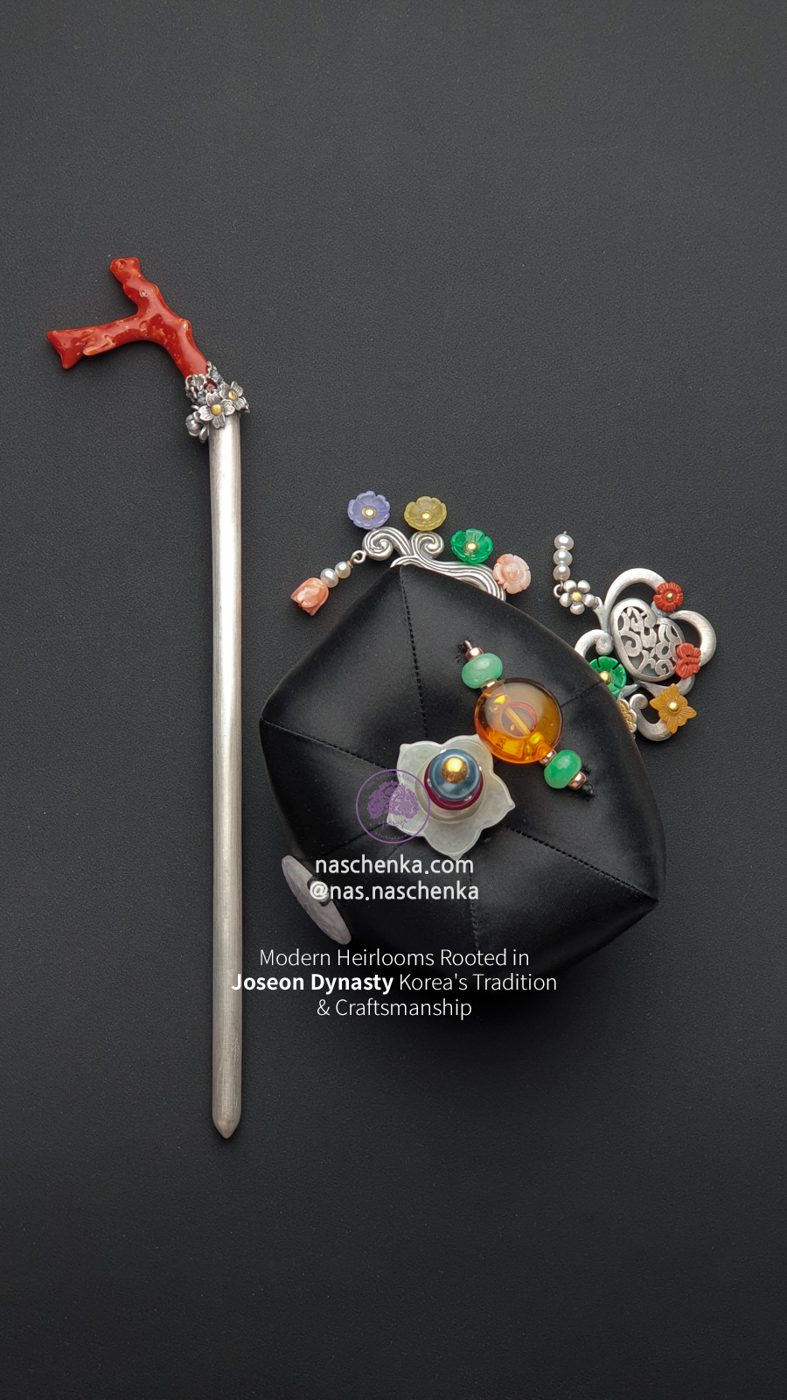
The binyeo is the long pin that passes through the chignon and holds it. It is the one essential ornament of the married woman's hairstyle. Its head can be plain or richly carved: dragon and phoenix heads, plum blossoms, bamboo, mushrooms. Materials ranged from wood and horn to silver, gold-plated silver, jade and coral, depending on rank, season and occasion.
Dwikkoji 뒤꽂이
The dwikkoji is added after the binyeo, into the finished chignon, purely for beauty or as a small tool. It is the subject of this whole guide; start at What is a dwikkoji?
Cheopji 첩지
The cheopji is a small ornament worn flat on the centre parting, at the top of the head. It was worn by the queen and by women with official court rank. Its form showed status. An empress wore a gilded dragon, queens and royal consorts a gilded phoenix, and ladies of lower rank a frog in gilded metal or black horn. It also helped hold a jokduri or hwagwan in place. The cheopji is not a dwikkoji: it sits on the front of the head, not in the chignon.
Tteoljam 떨잠
The tteoljam is the most dazzling ornament of the Joseon court. A jade plate, round, square or butterfly-shaped, is set with pearl, coral, jadeite and enamel. Small figures stand on fine metal springs around it and quiver with every movement. Three were worn on the great ceremonial wig: a butterfly-shaped one in the centre front and a round one on each side.
Daenggi 댕기
The daenggi is a ribbon of silk. Unmarried girls wore a long red daenggi at the end of a single braid. Married women tied the end of their braid with a small one before coiling it into the chignon. Brides wore elaborate ceremonial daenggi hanging down the back, embroidered and decorated with gold leaf.
Jokduri 족두리
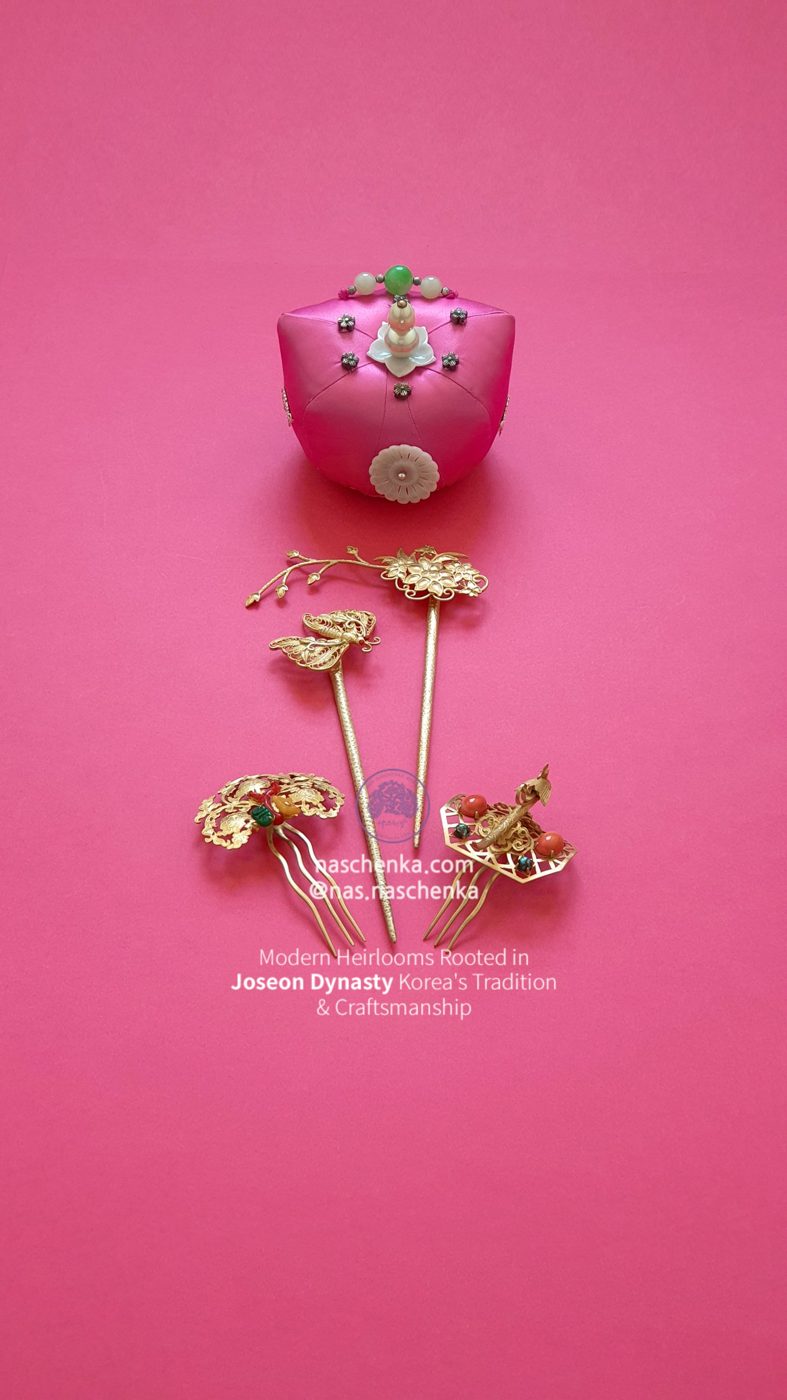
The jokduri is a small, six-sided black or coloured silk crown, decorated with jade, coral, pearl and metal ornaments. In 1756 King Yeongjo ordered it worn in place of the extravagant gache wig. It became the crown of the Korean bride, and still is at traditional weddings today.
Hwagwan 화관
The hwagwan is a more elaborate ceremonial crown, built up with flowers, butterflies and beads. It was worn by brides, court dancers and noblewomen at banquets.
Gache 가체
The gache was a wig of braided hair built high on the head, a symbol of wealth in the eighteenth century. Its extravagance led to the royal bans that made the chignon, and with it the binyeo and dwikkoji, the standard of Korean women's dress. Read the full story in the history of the dwikkoji.
And for men: sangtu-gwan
Joseon men also wore hair ornaments. A married man's topknot, the sangtu, was covered with a small cap, the sangtu-gwan (상투관), and pinned with a dongkot (동곳). These appear in many period dramas today.