The dwikkoji is an ornament for one hairstyle, the chignon. So its history is the history of how Korean women came to wear their hair in a chignon.
Early roots
Korean hair ornaments are very old. Murals in Goguryeo tombs already show women with their hair gathered at the back of the head, much like the later chignon. Gold and silver hairpins have been excavated from the tombs of the Three Kingdoms period (57 BCE – 668 CE). Small gold ornaments with three prongs are sometimes described as early ancestors of the dwikkoji.
Detailed records of how women dressed their hair from then until early Joseon are scarce. Scholars believe both the chignon and the tall, braided "up" styles were worn, but the evidence is fragmentary. The dwikkoji as we know it, a short ornament with one pointed end and a decorative head, belongs above all to the Joseon dynasty.
The age of the gache
For much of the Joseon period, the fashionable hairstyle for women of rank was not the chignon. It was the eonjeun-meori (얹은머리), hair built up high on the head with a gache (가체), a wig of braided extra hair. The bigger the gache, the higher the status. Korean sources trace the fashion back to Mongol-influenced styles of the Goryeo period. By the eighteenth century a fine gache could cost as much as a house. Stories circulated of families going into debt for one, and of a young bride whose neck was injured by its weight.
The royal bans: 1756 and 1788
The court tried for decades to end the gache. A formal proposal to ban it was made in 1747, during the reign of King Yeongjo. In 1756 Yeongjo prohibited the gache and ordered the jokduri, a small crown-like cap, to be worn instead. The ban was widely ignored.
In 1788 King Jeongjo restored the prohibition and had it written out in detail. The rules were published as the Gache Singeum Samok (가체신금사목), printed in both classical Chinese and Korean so that women could read it. Even this did not end the fashion immediately. Only from the middle of King Sunjo's reign, in the early nineteenth century, did the chignon become established across the country.
The chignon wins, and the dwikkoji flourishes
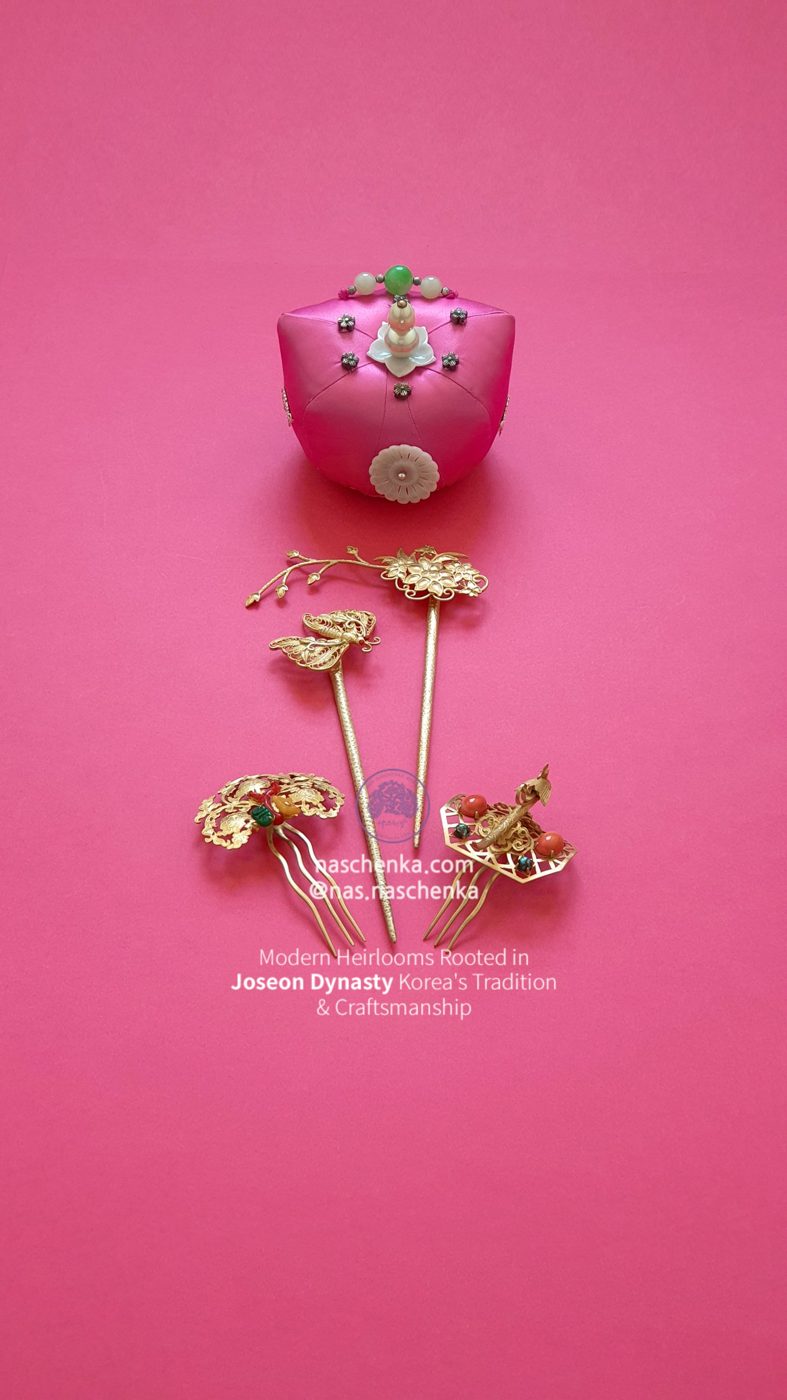
Once the chignon became the everyday hairstyle of married women, the ornaments worn in it multiplied. The bans moved status from the height of the hair to the quality of what was worn in it. The binyeo, the cheopji and the dwikkoji all became more elaborate. Korean costume historians note that the dwikkoji in particular grew far more varied after the gache was prohibited.
In fact the court soon found that women were decorating the chignon with such costly jewels that it, too, was criticised as extravagant. A ban on one luxury had simply moved luxury to a new place: the back of the head.
The chignon as a sign of marriage
Traditionally a girl's hair was put up at a coming-of-age ceremony called gyerye (계례), around the age of fifteen. Over time the chignon came to be put up at marriage instead, and the jjokjin-meori became the clear sign of a married woman. The dwikkoji therefore carried social meaning. It was jewelry that a married woman could wear and an unmarried girl could not.
Even the position of the chignon changed over time. It began high on the back of the head and slowly moved lower, until by the late Joseon period it sat just above the collar of the jeogori. After Korea opened its ports in the late nineteenth century, it moved up again to roughly where it is worn today.
Court and everyday dwikkoji
At court, rank governed everything, including hair ornaments. For the grandest ceremonies, royal women wore a large formal wig adorned with tteoljam (떨잠), ornaments with tiny springs that trembled as the wearer moved. These belong to the same family as the dwikkoji. For everyday court life and for noblewomen, dwikkoji in coral, jadeite, pearl and enamel were worn in the chignon.
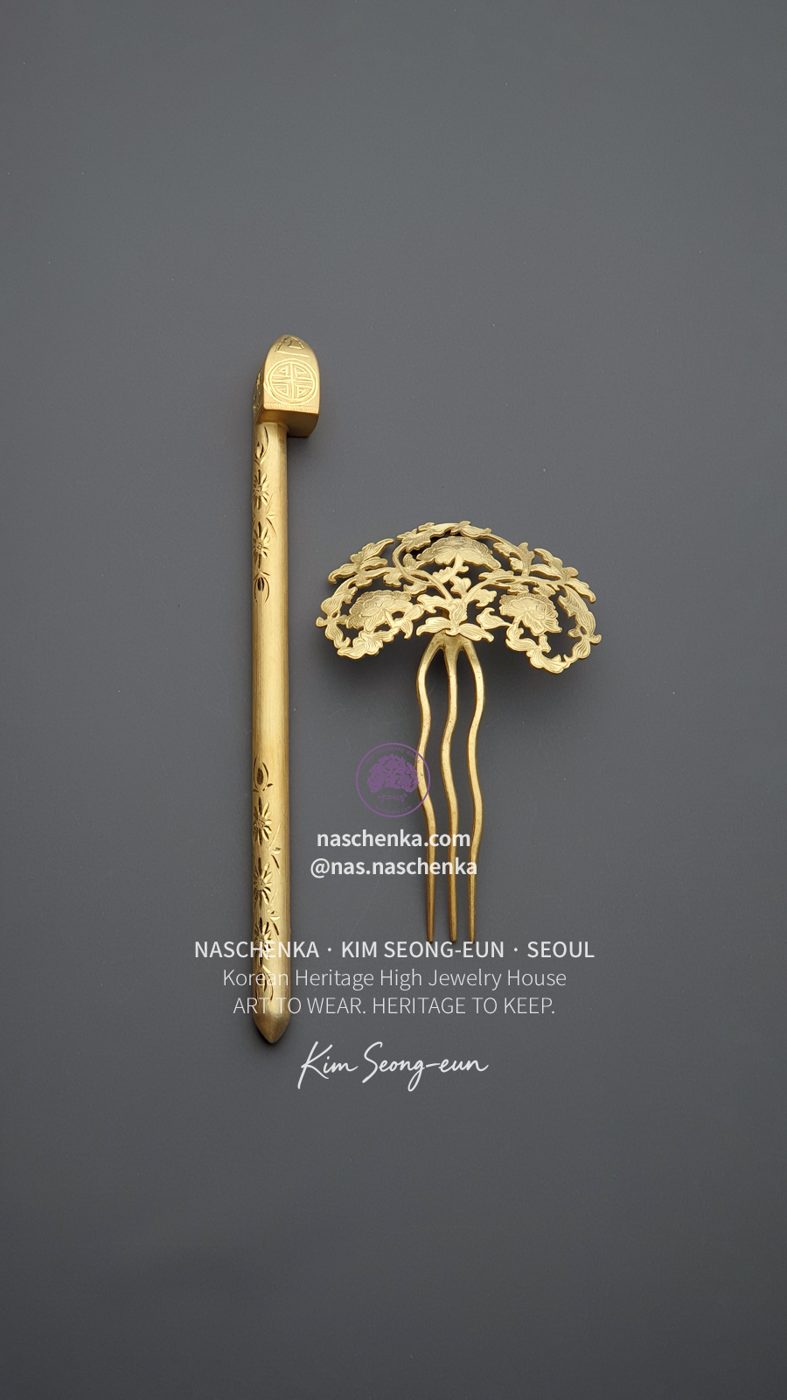
In ordinary households the most common dwikkoji were silver and practical. The guiigae (귀이개) was an ear pick with a decorative head. The bichigae (빗치개) was a flat tool used to part oiled hair and clean the teeth of a comb.
The twentieth century
From the early twentieth century, short haircuts and Western dress spread quickly in Korea. The daily chignon disappeared from city life within a few generations. The dwikkoji survived in three places: ceremonies, especially weddings; the traditional performing arts; and the work of craftspeople who kept making them.
The dwikkoji now
Today the dwikkoji is enjoying a revival. Interest in hanbok has grown with Korean dramas and K-pop. Couples once again marry in hanbok, and mothers of the couple wear a chignon with binyeo and dwikkoji. Collectors and visitors from around the world seek out pieces made the traditional way. NASCHENKA has made dwikkoji in Seoul since 2002, in 925 silver and natural stones, following the forms described on these pages.
Continue with the classic forms of the dwikkoji or what its motifs mean.
References
- Encyclopedia of Korean Culture — 뒤꽂이 (Dwikkoji)
- Encyclopedia of Korean Culture — 쪽머리 (Jjok-meori, chignon)
- Encyclopedia of Korean Culture — 가체 (Gache)
- Encyclopedia of Korean Culture — 가체신금사목 (Gache Singeum Samok, 1788)
- Academy of Korean Studies, Korean Costume Dictionary — 뒤꽂이
- Academy of Korean Studies — 쪽진 머리 (Jjokjin-meori)